
Why Animal Research Is Still Used — and Why That Is Changing


Understanding the scientific argument before deciding what should come next
At The Humane Future, I do not want to begin with a conclusion and then search for evidence that supports it.
I want to understand the evidence—even when it challenges what I believe.
If we are going to have a serious conversation about reducing and eventually replacing the use of animals in scientific research, we also need to understand an important question:
Why are animals still used in research at all?
For those of us who have seen former research animals begin new lives outside laboratories, that question can be emotionally difficult.
But understanding why some scientists continue to use animal models does not mean accepting every experiment involving an animal.
It means understanding the scientific problem we are trying to solve.
And if our ultimate goal is to develop science that no longer depends upon animals, understanding why researchers currently believe they need certain animal models is essential.
Animal Research Has Played a Role in Modern Medicine
There is no honest discussion of this issue that should erase the historical contribution of animal research to medicine.
According to the National Institutes of Health, carefully designed animal research has contributed to advances in understanding disease, biological processes and the development of treatments.
The National Academies has also documented the historical role of animal research in areas including organ transplantation, heart surgery and other medical procedures.
Animals have been used partly because humans and other animals share many biological processes.
Animals have circulatory systems, nervous systems, immune responses, hormones, organs and interacting biological systems. Depending upon the scientific question, researchers select species because particular aspects of their anatomy, physiology or genetics can model something researchers want to understand about human biology.
That does not mean an animal is simply a smaller version of a human.
It also does not mean that results obtained in animals will necessarily translate successfully to people.
That distinction is extremely important.
As someone who believes deeply in science and is grateful for advances in modern medicine, I do not believe we need to deny the contributions of animal research in order to question its future.
The more useful question is:
Which animal studies remain scientifically necessary today, and which can now be replaced?
Why Studying an Entire Living System Can Matter

One reason researchers have historically relied upon animals is the complexity of a living organism.
Imagine researchers discover a substance that kills cancer cells growing in a laboratory.
That is promising.
But researchers may still need to understand what happens when that substance interacts with an entire biological system.
How is it absorbed?
How is it distributed throughout the body?
How is it metabolized?
How is it eliminated?
Could it damage another organ?
Could the immune system react to it?
Could repeated exposure cause effects that were not visible in an isolated cell culture?
A human or animal body is not simply a collection of independent organs. Biological systems constantly interact.
This ability to observe effects across an intact organism has historically been one of the scientific arguments for animal research.
The FDA acknowledges that the complexity of a living biological system can be difficult to reproduce completely in a testing environment and that validated alternatives are not yet available for every type of safety question.
At the same time, that situation is changing rapidly.
Why Researchers Cannot Simply Begin With Humans
Before giving an experimental drug or treatment to people, researchers need evidence that helps them evaluate its potential risks.
It would obviously be unethical to expose people to completely unknown substances simply to discover what happens.
Historically, animal studies have been one source of preclinical safety information.
But an important change is underway.
The FDA does not now treat animal testing as the only acceptable path for producing nonclinical information.
The agency is increasingly encouraging validated New Approach Methodologies, commonly called NAMs, which can include human-cell systems, organoids, organs-on-chips and computational models.
In March 2026, the FDA issued draft guidance specifically intended to help developers validate NAMs for use in drug development instead of animal testing.
That represents a major shift.
Alternatives Already Exist
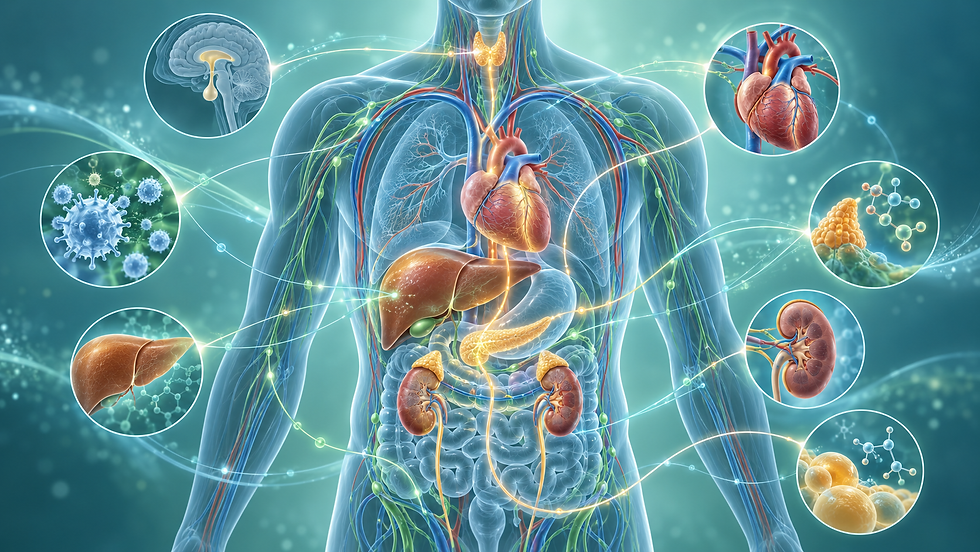
One misconception in this debate is that non-animal science belongs to some distant future.
It doesn't.
Alternative and complementary methods already include:
Human cells and tissues
Three-dimensional tissue models
Organoids
Organs-on-chips
Computer and mathematical modeling
In-silico approaches
Artificial-intelligence-assisted prediction
These approaches can sometimes supplement animal studies and, in appropriate circumstances, replace them.
The FDA is now actively encouraging development and validation of these methods.
The agency has even stated that its goal is to move away from animal testing as the default method for obtaining certain types of drug-safety information.
That is significant.
This is no longer simply an animal-welfare movement asking science to change.
Science itself is changing.
But Alternatives Cannot Yet Answer Every Question
This is where the conversation becomes more complicated.
The NIH's current position is that alternative methods cannot yet completely replace animals across biomedical research because no existing approach can reproduce every biological and behavioral aspect relevant to every research question.
That does not mean every current animal experiment is necessary.
It means that whether an alternative can replace an animal depends upon the particular scientific question being asked.
A method that successfully replaces an animal test for one form of toxicity may not be capable of answering an entirely different question involving the immune system, metabolism or complex behavior.
This is why the word validated matters.
Having a new technology is not enough.
Researchers and regulators need evidence showing that a method reliably answers the question for which it is
being used.
The FDA says new methods used for safety evaluation should demonstrate reliability and should provide information that is at least as useful as the methods they replace.
That seems like a reasonable standard.
We should not replace animal experiments with inferior science.
We should replace them with better science.
Animal Models Have Significant Limitations
Acknowledging why animal research is still used does not mean pretending animal models are perfect.
They are not.
Animals and humans can respond differently to diseases and treatments.
Differences in metabolism, genetics, immune systems and other biological processes can affect whether findings translate to people.
And the FDA itself is now publicly emphasizing this limitation.
In 2026, the agency stated that historically more than 90 percent of drugs that clear animal studies ultimately do not receive FDA approval, often because safety or effectiveness problems become apparent during human studies.
That statistic does not mean animal studies provide no useful information.
A drug can fail for many reasons, and passing an animal study was never a guarantee that it would become a successful human medicine.
But it does demonstrate something important:
Animal models are imperfect predictors of human outcomes.
That provides a scientific reason—not merely an ethical reason—to develop more human-relevant methods.
The FDA Is Moving Toward Human-Relevant Science
Perhaps one of the most important developments in this discussion is happening right now.
In 2025, the FDA announced a roadmap for reducing animal testing in drug development.
In March 2026, it released draft guidance providing a framework for validating alternatives.
In April 2026, the agency reported progress in implementing its strategy and reiterated its goal of replacing
unnecessary animal testing with approaches that more accurately predict what happens in humans.
The FDA specifically identifies technologies including:
organoids,
organs-on-chips,
advanced laboratory systems,
computer modeling, and
other human-relevant approaches.
The agency has also begun identifying circumstances in which certain animal studies may be eliminated or reduced.
That means the conversation is no longer simply:
Should animal research continue?
A better question may be:
How quickly can science develop, validate and adopt methods that outperform it?
The Three Rs
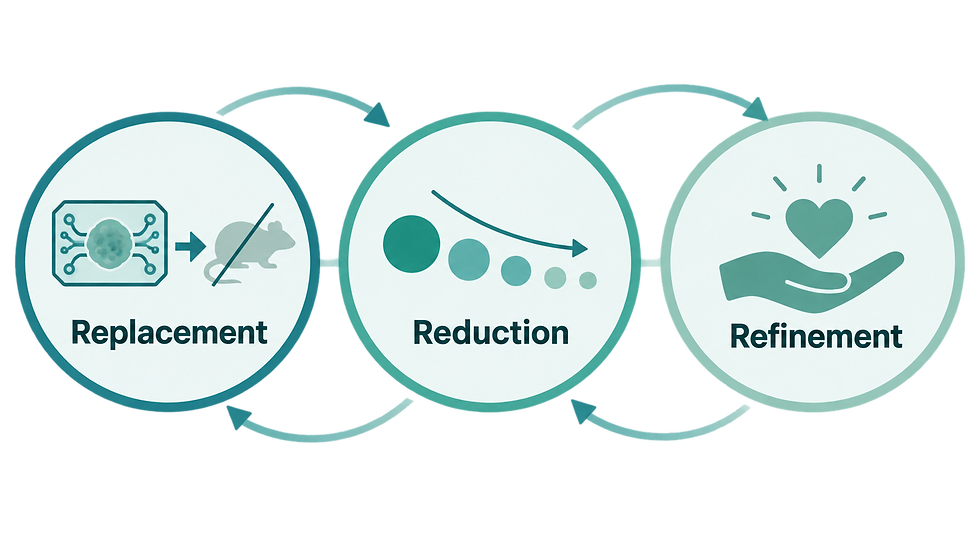
For decades, an important framework governing responsible animal research has been known as the Three Rs:
Replacement — replace animals with non-animal approaches whenever scientifically appropriate.
Reduction — use the minimum number of animals necessary to achieve valid scientific results.
Refinement — modify procedures to minimize pain, suffering and distress and improve animal welfare.
These principles were originally developed by William Russell and Rex Burch and remain influential in modern research policy.
NIH requires researchers it funds to consider the Three Rs when planning studies involving animals.
But perhaps the biggest opportunity today is to place far more emphasis on the first R:
Replacement.
Replacement should not mean simply waiting for somebody to invent an alternative.
It should mean deliberately investing in the science necessary to create one.
Necessary or Simply Traditional?
There is another question I believe deserves much greater attention.
Is an animal actually necessary for a particular experiment, or is the animal being used because that is how the experiment has traditionally been conducted?
Those are not the same thing.
Established scientific methods develop infrastructure around them.
Researchers become trained in particular models.
Laboratories acquire specialized equipment.
Historical data accumulate.
Regulatory expectations develop.
Replacing an established method therefore requires more than simply inventing something new.
The alternative must be evaluated, validated and accepted for its intended purpose.
This is one reason scientific transitions can take time.
But tradition alone should never be mistaken for scientific necessity.
Every use of an animal should have to answer a straightforward question:
Why is an animal needed for this particular study, and is there another scientifically valid way to obtain the
information?
For NIH-funded research involving vertebrate animals, researchers are already expected to justify why the animal model is appropriate, explain how many animals will be used, describe how pain and distress will be minimized and explain why another model or approach cannot accomplish the research objective.
That is exactly the type of scrutiny we should encourage.
Humane Treatment Should Never Be Optional
Even when an animal model cannot currently be replaced, scientific necessity cannot justify neglect or unnecessary suffering.
NIH specifically states that good animal care and good science go together.
Researchers receiving NIH support must address animal discomfort, distress, injury and pain and explain how those effects will be minimized.
There is an important scientific reason for this as well as an ethical one.
Poor welfare can introduce variables into experiments and potentially affect research results.
If society allows animals to be used because a study is considered scientifically important, then society assumes an extraordinary responsibility toward those animals.
Necessity should never become a blank check.
We Need Scientists at the Table
This is one reason I do not believe scientists should be treated as the enemy of animal advocates.
If we hope to create a future in which animals are no longer required for research, we need scientists to help build it.
We need researchers to explain exactly what information animal models currently provide.
We need toxicologists.
Physicians.
Veterinarians.
Engineers.
Biologists.
Regulators.
Computer scientists.
Experts in organs-on-chips.
Researchers developing organoids and human-cell models.
Artificial-intelligence specialists.
And animal-welfare advocates willing to keep asking whether something better is possible.
The conversation should not begin with:
“You are wrong.”
It should begin with:
“What does this experiment need to accomplish?”
Then:
“Can we accomplish it without an animal?”
If the answer is yes, we should.
If the answer is not yet, our next question should be:
“What would we have to develop so that someday the answer becomes yes?”
That is where I believe real progress begins.
Two Things Can Be True at Once
Something I am learning through this journey is that two apparently conflicting ideas can sometimes be true
simultaneously.
Animal research has contributed to scientific and medical knowledge.
And animal models have important limitations.
Some researchers currently believe animals remain necessary for particular scientific questions.
And government agencies are actively investing in technologies intended to replace them.
We do not have to rewrite history to advocate for change.
And we do not have to accept the status quo simply because something was useful in the past.
The methods that helped science reach this point do not necessarily have to be the methods that carry science into the future.
What The Humane Future Stands For
My vision for The Humane Future is not a future without science.
It is a future with better science.
It is not about pretending that every animal experiment can disappear tomorrow without consequences.
It is about refusing to assume that today's methods must continue indefinitely.
Replace animal experiments when scientifically sound alternatives already exist.
Reduce animal use when complete replacement is not yet possible.
Refine procedures and provide meaningful welfare protections for animals who remain in research.
Invest aggressively in technologies capable of replacing additional animal models.
Validate those technologies properly.
Encourage regulators to accept them when the evidence demonstrates that they work.
And continuously reconsider whether something that was necessary yesterday is still necessary today.
We can acknowledge what animal research contributed to the history of medicine while working toward a future
that depends upon animals less and less.
Perhaps one day science will reach the point where animals are no longer needed in biomedical research at all.
I hope it does.
Until then, I reject the idea that our only choices are human progress or animal welfare.
We should demand something much more ambitious:
Protect human health. Advance science. Reduce suffering. Follow the evidence. And build the technology that can make today's difficult choices unnecessary tomorrow.
That is the conversation I want The Humane Future to lead.
— Monia
Founder, The Humane Future
Sources
National Institutes of Health — Why Animals Are Used in Research
National Institutes of Health — When Are Alternatives to Animals Used in Research?
U.S. Food and Drug Administration — New Approach Methodologies (NAMs)
U.S. Food and Drug Administration — General Considerations for the Use of New Approach Methodologies in
Drug Development, Draft Guidance, March 2026
U.S. Food and Drug Administration — FDA Releases Draft Guidance on Alternatives to Animal Testing in Drug Development, March 18, 2026
U.S. Food and Drug Administration — FDA Achieves Year 1 Goals in Reducing Animal Testing in Drug Development, April 20, 2026
National Centre for the Replacement, Refinement and Reduction of Animals in Research — The 3Rs
National Research Council / National Academies — Science, Medicine, and Animals
Comments